Monday, December 02, 2019

Return of the Cronies

Datuk Seri Anwar Ibrahim and Tun Mahathir Mohammed
On October 17, Halim Saad, the executive chairman of Renong Group, bid RM5.2 billion (US$1.24 billion) in an attempt to acquire the government investment company Khazanah International’s majority interest in PLUS Malaysia Bhd., the country’s biggest highway concessionaire. 
Although Halim’s bid was said to be the highest, apparently Prime Minister Mahathir Mohamad would like to steer the ownership to another Tan Sri, Abu Sahid Mohamad of the Maju Holdings Group, a close friend and lunch partner of the premier. In the meantime, Lim Guan Eng, who heads the Finance Ministry, which controls Kazanah and thus the 51 percent PLUS stake, is fighting “tooth and nail,” in the words of one source, to keep it in the government.
If there is anything that exemplifies the paralysis that has seized the putative reform government that Malaysia’s voters put in place in May of 2018 – more than 500 days ago – it is the fight over PLUS, which could have come directly out of a 1980s playbook, a distressing indication that little has changed despite the electoral earthquake. 
“The problem is that these guys can’t get their act together,” said a highly placed business source. “Every single problem they have, they turn back to practices put in place by the old regime. Mahathir, Daim, and Anwar were part of the old regime. Now they are running the new one.”
Strangely, the reformers who formed the backbone of the resistance to the old regime have gone utterly silent. Rafizi Ramli, the articulate chartered accountant who embarrassed the old regime with his exposes of affairs like the “Cowgate” scandal, has disappeared from view. Tony Pua, the technocrat who joined the Democratic Action Party and exposed much of the misdoings in the 1MDB scandal, is little heard from. Nurul Izzah, Anwar’s daughter and a major voice for reform, has also basically disappeared. Azmin Ali, a Mahathir ally who previously had outmaneuvered his rivals in the Parti Keadilan Rakyat headed by Anwar Ibrahim, has been sidelined by allegations of sexual deviancy.
Voters have become disillusioned with a government in which very little has changed except that it has ceased to even function as well as the corrupt coalition that preceded it, critics say. Many of those critics are within the Pakatan Harapan coalition itself.
Instead of the generation of young reformers who helped to drive the Barisan from power, the country looks to the 94-year old Mahathir, who again took up the prime ministership 18 months ago. He is being challenged for the country’s leadership by his erstwhile ally Anwar Ibrahim, 72, who was the finance minister and a Mahathir acolyte three decades ago. Mahathir is being advised by Daim Zainuddin, 81, his finance minister from the 1980s. 
It was these government-linked companies, or GLCs, that stultified the Barisan Nasional and were in part responsible for Malaysia slipping behind other countries in the region. They included more than 30 such crony-driven operations as Malaysian Resources, UEM, PLUS, Renong, Malaysian Airlines, and Realmild. Abu Sahid, seeking to take over PLUS, is now the owner of Perwaja Steel, a failed white elephant that cost the government an estimated US$2.4 billion. MAS mismanagement is believed to have cost US$2 billion, UEM more than US$1 billion. A complete list of the companies that had to be taken over by the government can be found here
The political situation is “tense,” according to a political analyst, with everybody waiting to see how long Mahathir will remain. Although he had promised prior to the election to be gone in two years, with seven months or so left to go, he shows little inclination that he might actually give up. His party, Parti Pribumi Bersatu Malaysia, and his policies are increasingly appearing to be throwbacks to his previous prime ministership. 
The economy is reacting to the situation. While manufacturing foreign direct investment is on the increase as foreign multinationals look for other bolt-holes for their supply chains because of the US trade war with China, domestic investment has declined sharply, by 21 percent, with palm oil prices weakening. 
Mahathir then jolted the country recently by publicly backing Pakistan over India’s takeover of the autonomous region of Jammu & Kashmir, causing India to threaten a boycott of Malaysian palm oil. He also jolted Malaysia’s Chinese community by saying Hong Kong Chief Executive Carrie Lam should step down in the face of months-long protests, adding that eventually, China would crush the protests. In a majority Muslim country, he has argued that China is “too powerful” to censure over the issue of Beijing’s treatment of Muslim Uyghurs, leading to concerns that Malaysia is engaging in selective humanitarian criticism. Growing segments of the country are concerned that these statements are unnecessary and causing controversy that Malaysia doesn’t need – and raising questions over Mahathir’s fitness at age 94. 
One investment bank report suggested that political bickering has paralyzed reform. The private sector remains confused as to the rules of engagement, with ministers unsure of their roles, and holdover businessmen fearing both tax arears and possible criminal charges. 
The civil service, as Asia Sentinel reported on October 23, remains basically hostile to the government, with Mukhriz Mahathir, the prime minister’s son and chief minister of Kedah state, charging a veritable “fifth column” with allegiance to the previous government remains in place.  
Leaders from decades ago remain in charge, following the policies that got the country off the rails in the first place. Halim Saad, the executive chairman of Renong Group and Abu Sahid Mohamad are fighting for an entity that was invented as a state-backed creation tasked with pouring a cornucopia of money into the United Malays National Organization, then the dominant political party in the Barisan Nasional, the national ruling coalition, then headed by Mahathir. 
“Mahathir’s allies don’t want him to give up, they don’t want to give up their perks, the cronies are circling,” a source said. “UMNO and PAS have aligned together and they look to take advantage of a government that is looking paralyzed. Lots of people want to tell Mahathir to hang up his boots. But the majority don’t trust Anwar.”
Khairy Jamaluddin, the former youth minister in UMNO looked on as the party’s hope, has been silenced because he was looked upon as arrogant and far too ambitious. There “will be no comeback for 10 years even if he plays his cards right. The reformers are underground,” a political analyst said. “It looks like Anwar is the last man standing.”


Asia Sentinel.com

Tuesday, March 05, 2019

Malaysia’s Reformers Stumble


There has been some concrete progress. Former leaders including Premier Najib Razak, his wife Rosmah Mansor and the lawyer Mohammad Shafie Abdullah have been arrested. The Malaysian Anti-Corruption Commission has been removed from the prime minister’s jurisdiction along with the Election Commission. Judicial reform is moving slowly forward and the independent press has  been unleashed.
But generally the Pakatan Harapan coalition has presented a picture of stumbling from issue to issue, with infighting among the leaders as economic issues bite and with the ousted Barisan Nasional coalition doing its best to hamstring reform. The coalition has been blocked in parliament with doing away with a “fake news” bill pushed through at the last minute by Najib. Nor has it revoked the colonial-era sedition act – land in fact recently used against a former minister for questioning the appointment of non-Malays to top government positions, earning criticism from Amnesty International.
Voters hold their noses
Voter dissatisfaction was clear in the loss of the Selangor state constituency just a few kilometers from Kuala Lumpur, which fell to Zakaria Hanafi, a candidate for the United Malays National Organization by a 19,780 -17,866 margin, a swing of 11,000 votes away from the government in less than a year. The disgraced Najib campaigned energetically for Zakaria, excoriating the coalition on social media despite the fact that the former prime minister is under indictment in the massive US$4.8 billion 1Malaysia Development Bhd scandal.
It was the second loss to be suffered by the Pakatan Harapan coalition in recent weeks. On Jan. 26, again with Najib campaigning vigorously, a Barisan Nasional candidate, Ramli Mohd Nor, was elected to the national parliament, where the government coalition holds 125 of the 222 seats.
It is likely to not be the last loss. Another by-election is to be held next month in the rural constituency of Rantau, an UMNO stronghold southeast of the capital, and it will almost certainly be won by a Barisan Nasional candidate, which despite the composition of the district is likely to be psychologically damaging.
The 93-year-old Mahathir Mohamad appears to be having a difficult time holding his fractious coalition together. He and Anwar Ibrahim, who served as opposition leader during years of oppression including two extensive jail terms – one engineered by Mahathir – are plainly not getting along despite public shows of amity.  Anwar, who had pledged to take a two-year sabbatical from politics, shortly after the May election induced an allied Parti Keadilan Rakyat member of parliament to quit so that he could run for the seat, raising complaints that he was overly ambitious and impatient to take over.
Mahathir, having named Democratic Action Party Secretary General Lim Guan Eng finance minister, also named former Selangor chief minister Azmin Ali “minister of economic affairs,” setting up tensions over who is actually running the economics portfolio.  Nor does Azmin, now more closely aligned with Mahathir, get along with Anwar despite being a member of Anwar’s own party. Azmin is also at odds with Rafizi Ramli, the PKR secretary-general. Anwar’s daughter, Nurul Izzah, gave up her leadership position in the party over the slowing speed of reform.  Both she and Rafizi have largely been sidelined.
Unfilled pledges
The administration has run into heavy going over an unfulfilled pledge to reduce the cost of living as the economy slows. There have been policy missteps, with the government first announcing a RM1,150 (US$282.10) monthly minimum wage, then dropping the figure to RM1,000.
Pakatan Harapan had made the economy a major campaign issue and is paying for it. The World Bank projects slowing gross domestic product growth at 4.7 percent in 2019. Bank Islam Malaysia chief economist Mohd Afzanizam Abdul Rashid is warning that the economy could go into recession this year. 
Finance Minister Lim has belatedly lowered the cap on fuel prices and the administration is also seeking to replace the current high-cost highway toll regime – both campaign promises.  A campaign pledge to do away with an unpopular 6 percent goods and services tax has left the government scrambling for revenue. The consumer price index has started to rise again in the wake of a sharp fall after the GST was dropped.
Palm oil, a major export commodity, has fallen in price by 16 percent in the past year.  Crude prices have been trending down as well as US production has risen to more than 12 million bbl/day, taking a bigger share of the market and leaving small producers scrambling.
“The government, despite all of its promises, has failed to put food on the table for the majority of Malaysians,” said a local political analyst. “Not that things were improving under Najib, but that’s precisely the reason the voters threw out the Barisan, believing that Pakatan Harapan could change their lives.”
The Race CardThen there is the always-present concern over race and religion and Malay fear of loss of privilege. Ethnic Malays, all of whom are Muslims, and other indigenous peoples comprise 61.7 percent of the country’s 31 million people, the Chinese 20.8 percent with the remainder Indians and noncitizens. UMNO through its existence – egged on by the rural fundamentalist Parti Islam se-Malaysia – made its embrace of Islam and Malay welfare central to its governance, with government jobs and university positions all reserved for ethnic Malays. 


The Chinese-dominated Democratic Action Party is now a major leg of the four-party ruling coalition in a way that the largely subservient Malaysian Chinese Association never was, raising Malay suspicions that the Chinese will dominate politics the way they dominate economics.
Then there are the appointments that have traditionally gone to Malays. Lim Guan Eng, the secretary-general of the DAP, is now finance minister. Tommy Thomas, the attorney general, is an ethnic Indian. Richard Malanjum, 65, a Christian member of the Kadazandusun tribe in Sabah, has been made chief justice of the Federal Court, the country’s highest tribunal.
Najib and the Barisan have sought to exploit those appointments to show that Malays are being sidelined. There also has been a spate of incidents in which non-Malays have been accused of insulting Islam. There are also changing norms in government, with the armed forces, almost totally Malay, being opened to at least 10 percent non-Malays.
“The majority Malays feel that the new government hasn’t been sensitive to them,” said a source. “Like it or not, Muslims/Malays are the majority in the country and they guard their prerogatives jealously.”
Sham degrees
Then there is the issue of honesty in government. At least six Pakatan Harapan officials are under fire on allegations that they don’t possess real university degrees. Among them is Deputy Foreign Minister Marzuki Yahya, a member of Mahathir’s Parti Pribumi Bersatu, who claimed a Cambridge University degree. It turned out that the “degree” was from a diploma mill in the US called Cambridge international University. 
Mahathir is bringing along his own baggage with defectors from UMNO, which has earned the ire of the coalition partners. They include, among others, Hamzah Zainudin, a onetime Anwar acolyte who became a Najib loyalist, as well as Shabudin Yahaya, a former Najib aide who jumped ship when his boss was no longer in power.  They are members of an UMNO cadre who kept Najib in power allegedly through the force of outright bribes for years after he had been clearly identified by the US government as having allegedly stolen hundreds of millions of dollars from 1MDB.  
But beyond that, reformers say, race-based policies remain in place. Mahathir’s Parti Pribumi Bersatu – the united indigenous people’s party – makes no effort to disguise the fact that non-Malays need not apply. 
University Malaya Professor Terence Gomez, in a biting speech two weeks ago, charged that while Mahathir during the campaign, had promised to clean out rent-seeking, he was still allowing political appointments in government-linked companies.  He called attention to Mahathir’s embrace of onetime finance minister Daim Zainuddin, who during his tenure was widely believed to have enriched himself. The prime minister’s “council of elders” also includes, decides Daim, Zeti Akhtar Aziz, the former central bank governor, Hassan Marican, the former CEO of the national oil company Petronas, and Robert Kuok, the head of the Kuok group conglomerate. 
“Look at the political discourse,” Gomez was quoted in local media as saying. “Soon after they came to power, they said politicians will not be involved in business. But they reneged on that. They said no more race-based policies, but now we have the Bumiputera policy. It is a repeat of the discourse we have seen in the past.”  
“I think the voters decided to give these guys a kick in the groin,” said the KL-based political analyst about Sunday’s election. “I don’t think this is the end for PH. It’s a wakeup call. But if they continue screwing up as they have done the last 10 months, then it’s a matter of time before its curtains up for them.”


by AsiaSentinel.com

Malaysia’s Sub Scandal Resurfaces


What, until the US$4.5 billion 1MDB affair, had been Malaysia’s biggest scandal, has reappeared – the US$1.2 billion purchase of submarines under then-Defense Minister Najib Razak at the turn of the century, a lurid tangle of blackmail, bribery, murder, influence peddling, misuse of corporate assets and concealment.
Crusading French lawyer William Bourdon and his associate, Appoline Cagnat, are currently in Malaysia discussing the affair with Attorney General Tommy Thomas, according to local media. Bourdon and his associates compiled much of the evidence about the purchase at the turn of the decade for Suaram, the Malaysian good-government NGO, but he was kicked out of the country for attempting to follow up the case by Najib’s government.
The matter has remained in limbo since 2012 as the Najib government pulled out all the stops to keep it buried. Now, however, after the May 9, 2018 election that turned out the Barisan Nasional and brought the Pakatan Harapan coalition to power, the new government has shown considerable zeal in bringing long-buried scandals to the light.
The Scorpene submarines were purchased by Malaysia from subsidiaries of the state-owned weapons manufacturer DCN although there is no evidence that Malaysia ever needed submarines and in fact they had to be based in East Malaysia because the waters around Peninsular Malaysia were too shallow for them to operate efficiently.
According to evidence compiled by Asia Sentinel in a long series of articles that won the 2013 Award for Excellence in Investigative Reporting from the Society of Publishers in Asia – Asia’s version of the Pulitzer Prize – the transaction steered a €114.96 million (US$130.3 million at current exchange rates) kickback to the United Malays National Organization through a private company called Perimekar Sdn Bhd.
Perimekar was wholly owned by Abdul Razak Baginda and its principal shareholder was his wife, Mazlinda, a close friend of Najib’s wife Rosmah Mansor.  He was then the head of a Malaysian think tank called Malaysian Strategic Research.
DCN officials hinted that Perimekar had come into existence only to facilitate the kickback transaction. Documents note that “Perimekar was a limited liability company with a capital of MR5 million (€1.4 million) of which 1 million is available. It was created in August 1999 … it has no record of sales during 2000. Its ownership is in the process of restructuring.”
Razak Baginda was a close friend of Najib Razak, who went on to be Malaysia’s prime minister and would be booted out of office in disgrace over the 1MDB scandal, which later supplanted the Scorpene scandal by far.
Another €36 million was directed to an obscure company in Hong Kong named Terasasi Hong Kong Ltd., whose principal officers were listed as Razak Baginda and his father and which appeared to be nothing more than a name on an accounting firm’s wall. According to an August, 2017 story, Razak Baginda was charged by French prosecutors with “active and passive complicity in corruption.”
According to the documents made available to Asia Sentinel, some of the misdeeds appear to have taken place with the knowledge of top French government officials including then-foreign Minister Alain Juppe and with the consent of former – and current — Malaysian Prime Minister Mahathir Mohamad.
Top Thales officials been named in news stories in Paris as having suborned bribes in the matter. Najib was also named as the recipient.   However, given the involvement of such individuals as Juppe and others, it seems unlikely that the matter will be carried further in France despite a statement last July by French Ambassador to Malaysia Frédéric Laplanche that “Cooperation between France and Malaysia (on the investigation) is very good.”
As Asia Sentinel reported in 2012, the payment appears to have been in violation of the OECD Convention on Bribery, which France ratified on June 30, 2000. On Sep. 29, 2000, DCNI, a DCN subsidiary, “took corrective actions” after France joined the bribery convention. Contracts concluded after that date were to be routed to companies held by Jean-Marie Boivin, DCN’s former finance chief, headquartered in Luxembourg and Malta respectively.
Among the documents is one that shows Boivin paid to send Razak Baginda on a jaunt to Macau with his then-girlfriend, Altantuya Shaariibuu, a jet-setting Mongolian national who was later murdered by two of Najib’s bodyguards in gruesome fashion in October of 2006 and whose body was blown up with C4 explosives, possibly to destroy the fetus of the child she said she was carrying when she was killed.
In a handwritten note found in her hotel room after she had been murdered, Altantuya said she was blackmailing Razak Baginda for US$50,000, although she didn’t say why. However, according to the documents, she had considerable knowledge of the purchase of the submarines from her relationship with the defense analyst. And, although Najib has repeatedly denied it and sworn on the Quran that he had never met her, there is evidence that he had not only met her but had an affair with her before Razak Baginda.
Two of Najib’s bodyguards, Azilah Hadri and Sirul Azhar Umar, the latter of whom left the country when he was temporarily freed by an appeals court and remains in Australia, were tried and convicted of her murder in a long-running trial that appeared to be carefully orchestrated to make sure nobody above the two bodyguards was ever named despite the fact that one of them, in a sworn statement, said they were to be paid MYR50,000 to carry out the killing. Musa Safri, Najib’s aide de camp, was identified as the individual who designated Azilah and Sirul to pick up Altantuya. But there is no evidence he was ever questioned by the police about his involvement.
In June 2018, the then-newly appointed Inspector-General of Police Mohamad Fuzi Harun told reporters that an investigation into Altantuya’s death would be reopened, based on a new police report submitted by Altantuya’s father. So far there has been little public indication of progress
The story, which was considerably bigger than just the Scorpenes, in essence began when Najib was appointed defense minister in Mahathir’s cabinet in 1991 and embarked on a massive buildup of the country’s military, arranging for the purchase of tanks, Sukhoi jets, coastal patrol boats – and submarines, all of which appear to have been mired in corruption and kickbacks that enriched Najib and UMNO. French, German, Swedish, Russian and Dutch manufacturers in turn went looking for the most effective cronies of the Malaysian leadership to help them out.
“The major defense contracts in Malaysia as in other countries require substantial money transfers to individuals and/or [political] organizations,” according to documents taken from DCN’s files by French investigators. “In Malaysia, other than individuals, the ruling party [UMNO] is the largest beneficiary. Consultants [agents or companies] are often used as a political network to facilitate such transfers and receive commissions for their principals.”


by AsiaSentinel.com

Thursday, September 06, 2018

In Malaysia, China Risks a Neocolonialist Tint


At the end of his Aug. 17-21 China visit, Malaysian Prime Minister Mahathir Mohamad announced that US$22 billion of Chinese-backed infrastructure projects in his country would be temporarily or permanently cancelled. The world will be watching China’s subsequent actions to see whether they will take on a neocolonialist tint.

The Belt and Road Initiative is Chinese President Xi Jinping’s grandiose plan to connect China with South, Central and Southeast Asia, the Middle East, Russia, Africa, Latin America and Europe through infrastructure projects including roads, ports, airports and railways.

The broad geographic reach of the BRI, as it has come to be known, has raised questions whether China intends to use this project for imperial expansion. As Asia Sentinel has previously reported, Sri Lanka, Cambodia and Pakistan have found themselves so deep in debt to the Chinese that there are fears political domination will follow. The risk is that Malaysia is on the same course.

The postponed Malaysian projects include an East Coast Rail Link and two energy pipelines.  Mahathir said told a Beijing press conference on Aug. 21 that the three would be “deferred until such time we can afford, and maybe we can reduce the cost also if we do it differently. It’s all about borrowing too much money which we can’t afford, can’t repay, and also we don’t need those projects for Malaysia at this moment.”

The vast majority of the funding for three — US$20 billion for the rail link and US$2 billion for the pipelines – has been supplied by the Export-Import Bank of China (Exim Bank), a state-owned policy lender. Chinese state-owned firms are the main contractors of these three projects, raising criticism that Malaysians are being denied jobs, as they have been in several countries where the belt and the road have reached.

At a press conference of China’s Ministry of Foreign Affairs on the same day, when asked about the cancellation of these projects, a Chinese foreign ministry spokesman said, “Of course, cooperation between any two countries may encounter some problems, and different views may emerge at different times. These problems should be properly resolved through friendly consultations without losing sight of the friendship enjoyed by the two countries and the long-term development of bilateral ties, which, I can assure you, is also an important consensus reached during Prime Minister Mahathir’s visit to China.”

Mahathir was tactful enough not to criticize China for these stalled projects, but to lay the blame on his predecessor Najib Razak, who had approved them projects while he was Malaysia’s premier. After being ousted in a shock defeat in the Malaysian elections on May 9, Najib is facing corruption charges over the hugely mismanaged and corrupt 1Malaysia Development Bhd, backed by the Ministry of Finance.

However, Mahathir warned China against being a neocolonialist. At a press conference in Beijing with Chinese Prime Minister Li Keqiang on Aug. 20, when asked by Li whether he supported free trade, Mahathir replied, “I agree free trade is the way to go, but, of course, free trade should also be fair trade. We do not want a situation where there is a new version of colonialism happening because poor countries are unable to compete with rich countries, therefore we need fair trade.”

Ironically, Chinese state propaganda expresses similar opposition to colonialism, in its messages conveyed in two Beijing museums, the National Museum and the China Railway Museum. As stated part of the reason for the Republican Revolution of 1911 was the Chinese people’s opposition to foreign domination of China’s railroads. By 1911, foreign powers, including Russia, Japan, Germany, Britain and France, controlled 93 percent of China’s railways, a display in the National Museum pointed out. The Qing government had to pay off huge debts to foreign banks which had bankrolled these railroads.

Around the turn of the 20th century, the Qing government nationalized railways owned by private Chinese businesses, then sold them to foreign interests. This sparked a rebellion, causing the Chinese imperial government to transfer troops from the Chinese city of Wuhan to quell a rail revolt in Sichuan province. As a result, the Wuhan garrison was undermanned, which enabled an uprising in Wuhan to succeed in October 1911, which in turn toppled the Qing dynasty.

Going forward, the Chinese government must avoid provoking resistance to Chinese-funded infrastructure projects in BRI countries whose governments and peoples fear dependency, just as China was reduced to a semi-colonial state by foreign dominance of its infrastructure. Currently, BRI projects are mostly financed by Chinese state-owned banks, just as foreign banks funded most of the railway in China during the Qing dynasty.

At the Aug. 20 press conference, Mahathir expressed his wish that Beijing will be sympathetic to Malaysia’s heavy debt and help resolve its fiscal problems. At the press conference on August 21, the 93-year old leader said, “I believe China itself does not want to see Malaysia become a bankrupt country.”

The Chinese government has a vested interest in ensuring Malaysia’s economy is not sunk by crushing debt if Beijing and Chinese state-owned firms wish to avoid a repeat of the derailment of a US$7.5 billion rail project in Venezuela.

On Apr. 11, 2013, the South China Morning Post reported that this 475 km railway, built by the state-owned China Railway Group, was delayed because the Venezuelan government was unable to pay the entire US$7.5 billion contract. The Venezuelan government owed China Railway US$400 million to US$500 million, Li Changjin, the chairman of China Railway, was quoted as saying. “The reason is the Venezuelan government has no money.”

Onsite media reports in 2016 showed China Railway’s facilities in its Venezuela project were apparently abandoned.

Since 2013, Venezuela’s economy has been in a dire state, with high inflation and difficulty repaying its debts. If Beijing wants the BRI to succeed in countries like Venezuela and Malaysia, it must ensure that costly infrastructure projects do not harm these countries’ economies. Otherwise, trade and investment between them and China will suffer.

During their Aug. 20 meeting, Xi told Mahathir their nations should have pragmatic cooperation, seeking innovative new models of cooperation. Xi must find viable models of cooperation over BRI if he wishes to avoid blowback against Chinese projects in Malaysia. Only then can Xi demonstrate that Belt and Road is not a Trojan Horse for Chinese imperialism, and convince nations to accept the vast infrastructure projects.


Toh Han Shih is a Singaporean writer in Hong Kong

Tuesday, June 26, 2018

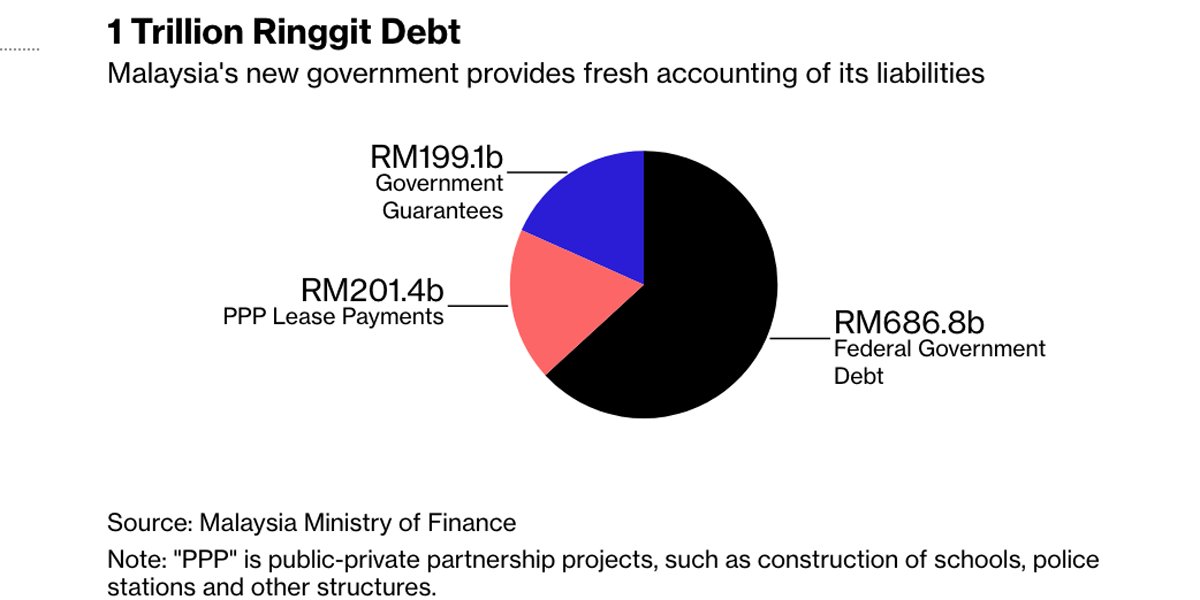
This Chart Shows How Najib Drove The Country To RM1 Trillion In Debt

Related image

We wish to say “I told you so” again. But to hear it from the horse mouth – Mahathir – is equally satisfying. Yes, Malaysia has already breached the RM1 trillion marks, for the wrong reason. Speaking for the first time to staff of the prime minister’s office, Mahathir revealed the troubling debts accumulated, thanks to 9 years of corrupt Najib administration.

When Mahathir resigned in 2003 after ruling for 22 years (1981 to 2003), the debt was only about RM190 billion. After he passed the baton to Abdullah Badawi, the sleeping head doubled the nation’s debt to about RM380 billion. But after Najib Razak took over the country, he tripled it to RM1 trillion in debts. In short, Najib doubled the debt in 4 years what Badawi would have done in 8 years.

During the 14th election campaign, Najib Razak conveniently used the national debt as a weapon to attack his opposition. He warned the people that a victory for the opponent coalition Pakatan Harapan’s would cause debt to skyrocket. He claimed that the opposition’s promise to abolish GST (goods and services tax) and road toll collection would increase national debt to RM1.1 trillion.

Malaysia Government Gross Debt 1990-2017 Q1 - Finance Minister Performance
Najib, of course, didn’t want the people to know that his regime had already clocked the RM1 trillion figures. By first quarter of 2017, the country was already burdened with RM916.12 billion. Since Najib came to office in 2009, Malaysia’s debt has grown at an average of 10% a year. Hence, if you look at the government gross debt chart, the first number of debt figure will jump – every year (get the picture?).

The worst part is this – despite abolishing subsidies for petrol, diesel, sugar, cooking oil, electricity tariffs, water and whatnot, Najib regime somehow still couldn’t find the money to run the government efficiently. The son of Razak was practically stealing rice from a beggar’s bowl when he introduced 6% GST (goods and services tax) on 1 April 2015.

Do you need more proof that the despicable and corrupt Najib had been stealing from the people to live lavishly? The clearest proof of excessive spending, and even corruption for that matter, can be found in this chart – the yearly allocation for the Prime Minister Office (PMO). In his first year as prime minister, the budget for the PMO breached RM10 billion for the first time in the history.

budget-2017-malaysia-prime-minister-office-pmo-allocation-2000-2017

The yearly budget for the PMO continued to climb and reached the climax when it hit the RM20 billion in 2016. Now we know why a small nation with 32-million populations need to pay RM20 billion for the operation of Najib’s office. After the stunning defeat of Barisan Nasional coalition government, it is discovered that a whopping 17,000 “political appointees” were hired by the previous government.

Prime Minister Mahathir Mohamad, shocked, said the contracts for the highly paid 17,000 “political appointees” will be axed. This will reduce the expenditure. Assuming each of them was paid a conservative RM5,000 every month, the annual expenses would hit RM1 billion already. When Mahathir resigned in 2003, the PMO was allocated merely RM3.5 billion.

However, paying top dollar for 17,000 “political appointees” to boost Najib’s image wasn’t the only wastage policy adopted by the former prime minister. His wife, Rosmah Mansor, was the biggest beneficiary from the massive yearly budget to the PMO. Auntie Rosie’s pet project – Permata Programme – was allocated RM100 million and RM111 million in 2010 and 2011 Budget respectively.

When Najib presented the 2013 Budget, the so-called pre-school education programme was allocated a whopping RM1.2 billion. The amazing part about the “Permata” programme is that nobody knows how the money was being used. In fact, the programme has been such a cash-cow to Rosmah that even after his husband has lost, she insisted the new government to retain the project.

Najib’s previous government operated without transparency. As the finance minister himself, he spent excessively and lavishly without thinking about the source of income. His answer to lack of funding was to borrow money. One of Najib’s tricks in hiding the RM1 trillion debts accumulated over the years – exclude the government-guaranteed debt.

Based on statistic from Bank Negara Malaysia (Central Bank), the debt guaranteed by the Federal Government is at eye-popping RM238 billion. And thanks to the declassification of 1MDB audit report after Najib was defeated in the 14th general election, it has been revealed that the state investment fund was drowning in debt. Now, where is that Arul “Anaconda” Kanda guy when you need him the most?

1MDB Scandal - How Najib Becomes A Billionaire and Fund His Wife’s Diamonds

According to the audit report – assuming there are no new loans after October 2015 – it was estimated that RM42.26 billion was needed to pay the principal and interest that will be due between November 2015 and May 2039. 1MDB also needs a minimum of RM1.52 billion every year for 10 years from November 2015 to May 2024 just to pay back its loans.

In short, the declassified report said the scandal-tainted firm had debt commitments totalling RM74.6 billion, inclusive of interest and borrowing costs, from November 2015 to 2039. That’s about RM3 billion of debt commitment every year – for the next 25 years. This is what going to make the country in serious trouble, if billions of dollars plundered by Najib is not recovered.

Now, do you understand why newly sworn-in finance minister Lim Guan Eng is roped in to clean the shit left by the former Thief-in-Chief Najib Razak? Based on his track record in managing Penang finances, only Mr. Lim has the ability to fix the problem. Crooked Najib was essentially driving the country to the brink of bankruptcy, had he not stopped in time.


Copyright 2006-2018. FinanceTwitter. All rights reserved

Sending A Message To China – Here’s Why Mahathir’s Visit To Japan Is A Brilliant Strategy

Image result for mahathir visit japan
Had Najib Razak won the 14th general election on May 9th, his first foreign visit will most likely be China. He would go there and brag how his Barisan Nasional coalition government had used President Xi Jinping photo on campaign billboard. He would offer Xi to restart the stalled “Bandar Malaysia” project in exchange for kickbacks, and sell more national treasure to China.

Yes, as revealed by the new government, the Najib regime had “secretly” used taxpayers’ money to bail out 1MDB since April 2017 to the tune of RM6.98 billion, and counting. And he would certainly continue to sell more strategic assets to China. The revelation that Malaysia has breached the RM1 trillion in debts confirms the country was on the brink of bankruptcy.

Judging by how the defiant Najib continues to twist and deny about the RM1 trillion debt and 1MDB bailout, it’s safe to presume the mad son of Razak would most likely continue to borrow and hide the debts using creative accounting – had he won on May 9th. Unfortunately to the ex-prime minister, his lucky number didn’t work and his wife’s black magic had failed spectacularly.

While the new government is trying to fix the financial havoc left by the previous government, where the ex-PM Najib helped himself to the national coffers as if they were his personal piggie bank, there’s one problem that has gotten Mahathir cracking his 93-year-old head – China. Between the corrupted Najib and the no-nonsense Mahathir, the choice isn’t hard for Beijing.

As China aggressively grows its influence in its backyard and worldwide, a greedy and corrupt scumbag like Najib is what the Middle Kingdom desires. Najib can be controlled and become China’s puppet. But with Mahathir, a man who doesn’t fancy women, let alone hungry for money, Beijing will be having problem transforming Malaysia as its obedient puppet against the United States in the region.

However, at the same time, Mahathir – world’s oldest prime minister – cannot afford to offend China. What the world’s second largest economic powerhouse needs to do to give a hard time to the newly installed prime minister is to stop importing palm oil from Malaysia. When the palm oil prices plunge, the Felda settlers, mostly ethnic-Malay, would be sharpening their knives for Mahathir’s head.

That was why Malaysia’s richest man – Robert Kuok – was invited to be one of five members of a special advisory council, which Mahathir called the “council of the elders”. Kuok was chosen because of his special relationship with Beijing, including President Xi Jinping. It is hoped that Kuok could facilitate projects re-negotiation between Kuala Lumpur-Beijing.

Still, like other countries being trapped in the so-called China’s OBOR (One Belt One Road) flagship project, Malaysia owes huge debts thanks to Najib Razak. Based on data compiled by “This Week in Asia” from 11 high-profiles, controversial projects signed during the Najib administration was in the region of US$134 billion worth of Chinese investment.

Those projects, involving 13 Chinese companies and financial institutions, range from real estate development to infrastructure construction and large-scale industrial plants. Most of them were signed in the last 5 years and remain under construction. One of them includes the ongoing East Coast Railway Link (ECRL), a wasteful project where the cost has been inflated to RM55 billion.

About 85% of the ECRL railway project is financed by Chinese soft loans from China Exim Bank. Mahathir has clarified that while he’s not anti-China, his administration is indeed against the huge borrowing. Sure, Mahathir can, with helps from Robert Kuok, renegotiate the terms of projects such as ECRL. But it is unlikely to be terminated. China won’t allow it to happen, for obvious reason.

Costing RM55 billion at its initial first phase, the ECRL is expected to cost taxpayers RM92 billion by the time it paid off its due interest. The second phase would cost another RM11 billion. The contract for the ECRL was obviously “strange” – the terms state that the contractor must be from China while the borrowings of RM55 billion to fund the project must also come from the country.

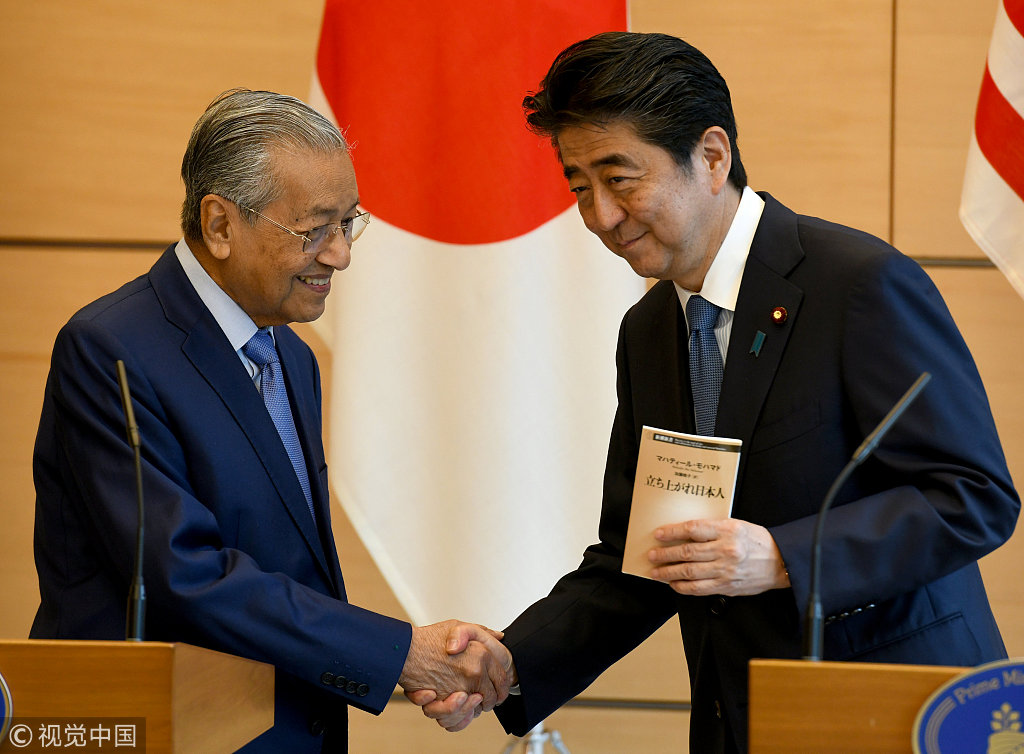
Enter Japan – Mahathir Mohamad’s first foreign destination. Scheduled to take place on June 11-12, the Malaysian 7th prime minister will attend the annual Nikkei Conference and is expected to rub shoulders with Japan Prime Minister Shinzo Abe, whom called Mahathir on May 24 to specifically congratulate him on the formation of the new government.

The relationship between Mahathir and Japan went as far back as 1981 when the Malaysian premier promoted “Look East” policy. The policy was mooted to encourage Malaysian students in Japan to bring back knowledge and acquire Japanese cultural virtues such as work ethics, discipline and punctuality – in addition for Japan’s assistance in Malaysia’s development.

This time, Mahathir, making a comeback after ruled for 22 years (1981 to 2003), is expected to request for assistance not only to reduce the huge borrowings but also to seek investments to boost Malaysia’s economy and to instil investors’ confidence. And Japan will gladly help in whatever way possible as the Japanese is fast losing its shine among Southeast Asian countries.

Tokyo has suffered a series of foreign policy setbacks in the region as an increasing number of ASEAN (Association of Southeast Asian Nations) members began gravitating toward China’s enormous and fast growing economy. Besides former Singapore Prime Minister Lee Kuan Yew, Mahathir is the only leader who had refused to “kow-tow” to powerful nation such as China.

More importantly, Mahathir’s revisit of his “Look East” policy is a strategic move to send a message to China – that Malaysia has other wealthy friends such as Japan. And guess which country that China hates the most in the region. Yes, it’s none other than the Japanese. Most of ASEAN countries have been charmed by China’s deep pocket.

Despite his advanced age, Mahathir’s aura cannot and should not be underestimated. After all, not a single foreign country had predicted the stunning victory of the old man. Therefore, Mahathir’s visit and comments in Japan will be closely watched and scrutinized. He could share his critical view about China’s naval expansion in the South China Sea.


Mahathir could probably use the platform in Japan to tell China that unlike the disgraced Najib Razak, he is not ready to bend over in exchange for kickbacks. That Mahathir cannot be bribed and refused to be controlled will make China more than willing to re-negotiate the present lopsided projects not favourable to the Malaysian people.

In the same breath, PM Mahathir might drop the Singapore-Kuala Lumpur high-speed rail (HSR) project, although the 350-km rail deal between Singapore and Malaysia had been inked in 2016 under the previous PM Najib Razak. Already, the new Malaysian government is studying how much they need to pay in the event the RM100 billion “wasteful and unnecessary” HSR project is scrapped entirely.

However, one cannot underestimate whether this is one of Mahathir’s negotiation tactics to force Singapore and China to submit to his demands. Mahathir may threaten to drag Singapore to international court to arbitrate if the terms of the HSR project are too heavily weighted in one party’s favour, which in this case is Singapore, of course.

Despite scoring high marks on Corruption Perceptions Index, Singapore isn’t as clean as many think. It wasn’t until the F.B.I opened investigation papers and Switzerland dropped the bombshell  that a criminal investigation into 1MDB had revealed that about US$4 billion appeared to have been misappropriated from Malaysian state companies, that Singapore was forced to act in early 2016.

Therefore, Mahathir could use HSR project to paint Singapore as a crook working together with Najib. One way or another, Singapore had aided Najib steal and stash billions in the island. That was why an hour after Singapore Prime Minister Lee Hsien Loong left Mahathir’s office, embarrassingly, it was announced that all bilateral deals signed by ex-PM Najib Razak has to be re-looked at.

Even if Mahathir cannot cancel the HSR project, bringing Japan to the table could send shivers down China’s spine. With over US$134 billion worth of investment, China will do anything to secure their investment and influence in the country. And the Chinese definitely do not want Malaysia to side with Singapore, let alone Japan, in any dispute with them.

Beijing considers Singapore as a proxy of the U.S., hence both countries doesn’t see eye to eye. Likewise, Singapore doesn’t want to see China hardware in their backyard. It becomes merrier when the Japanese are thrown into the party, either as new banker or new player. Mahathir will definitely squeeze something juicy from his visit to Japan.

Had Najib Razak won the 14th general election on May 9th, his first foreign visit will most likely be China. He would go there and brag how his Barisan Nasional coalition government had used President Xi Jinping photo on campaign billboard. He would offer Xi to restart the stalled “Bandar Malaysia” project in exchange for kickbacks, and sell more national treasure to China.

Yes, as revealed by the new government, the Najib regime had “secretly” used taxpayers’ money to bail out 1MDB since April 2017 to the tune of RM6.98 billion, and counting. And he would certainly continue to sell more strategic assets to China. The revelation that Malaysia has breached the RM1 trillion in debts confirms the country was on the brink of bankruptcy.

Judging by how the defiant Najib continues to twist and deny about the RM1 trillion debt and 1MDB bailout, it’s safe to presume the mad son of Razak would most likely continue to borrow and hide the debts using creative accounting – had he won on May 9th. Unfortunately to the ex-prime minister, his lucky number didn’t work and his wife’s black magic had failed spectacularly.

While the new government is trying to fix the financial havoc left by the previous government, where the ex-PM Najib helped himself to the national coffers as if they were his personal piggie bank, there’s one problem that has gotten Mahathir cracking his 93-year-old head – China. Between the corrupted Najib and the no-nonsense Mahathir, the choice isn’t hard for Beijing.

As China aggressively grows its influence in its backyard and worldwide, a greedy and corrupt scumbag like Najib is what the Middle Kingdom desires. Najib can be controlled and become China’s puppet. But with Mahathir, a man who doesn’t fancy women, let alone hungry for money, Beijing will be having problem transforming Malaysia as its obedient puppet against the United States in the region.

However, at the same time, Mahathir – world’s oldest prime minister – cannot afford to offend China. What the world’s second largest economic powerhouse needs to do to give a hard time to the newly installed prime minister is to stop importing palm oil from Malaysia. When the palm oil prices plunge, the Felda settlers, mostly ethnic-Malay, would be sharpening their knives for Mahathir’s head.

That was why Malaysia’s richest man – Robert Kuok – was invited to be one of five members of a special advisory council, which Mahathir called the “council of the elders”. Kuok was chosen because of his special relationship with Beijing, including President Xi Jinping. It is hoped that Kuok could facilitate projects re-negotiation between Kuala Lumpur-Beijing.

Still, like other countries being trapped in the so-called China’s OBOR (One Belt One Road) flagship project, Malaysia owes huge debts thanks to Najib Razak. Based on data compiled by “This Week in Asia” from 11 high-profiles, controversial projects signed during the Najib administration was in the region of US$134 billion worth of Chinese investment.

Those projects, involving 13 Chinese companies and financial institutions, range from real estate development to infrastructure construction and large-scale industrial plants. Most of them were signed in the last 5 years and remain under construction. One of them includes the ongoing East Coast Railway Link (ECRL), a wasteful project where the cost has been inflated to RM55 billion.

About 85% of the ECRL railway project is financed by Chinese soft loans from China Exim Bank. Mahathir has clarified that while he’s not anti-China, his administration is indeed against the huge borrowing. Sure, Mahathir can, with helps from Robert Kuok, renegotiate the terms of projects such as ECRL. But it is unlikely to be terminated. China won’t allow it to happen, for obvious reason.

Costing RM55 billion at its initial first phase, the ECRL is expected to cost taxpayers RM92 billion by the time it paid off its due interest. The second phase would cost another RM11 billion. The contract for the ECRL was obviously “strange” – the terms state that the contractor must be from China while the borrowings of RM55 billion to fund the project must also come from the country.

Enter Japan – Mahathir Mohamad’s first foreign destination. Scheduled to take place on June 11-12, the Malaysian 7th prime minister will attend the annual Nikkei Conference and is expected to rub shoulders with Japan Prime Minister Shinzo Abe, whom called Mahathir on May 24 to specifically congratulate him on the formation of the new government.

The relationship between Mahathir and Japan went as far back as 1981 when the Malaysian premier promoted “Look East” policy. The policy was mooted to encourage Malaysian students in Japan to bring back knowledge and acquire Japanese cultural virtues such as work ethics, discipline and punctuality – in addition for Japan’s assistance in Malaysia’s development.

This time, Mahathir, making a comeback after ruled for 22 years (1981 to 2003), is expected to request for assistance not only to reduce the huge borrowings but also to seek investments to boost Malaysia’s economy and to instil investors’ confidence. And Japan will gladly help in whatever way possible as the Japanese is fast losing its shine among Southeast Asian countries.

Tokyo has suffered a series of foreign policy setbacks in the region as an increasing number of ASEAN (Association of Southeast Asian Nations) members began gravitating toward China’s enormous and fast growing economy. Besides former Singapore Prime Minister Lee Kuan Yew, Mahathir is the only leader who had refused to “kow-tow” to powerful nation such as China.

More importantly, Mahathir’s revisit of his “Look East” policy is a strategic move to send a message to China – that Malaysia has other wealthy friends such as Japan. And guess which country that China hates the most in the region. Yes, it’s none other than the Japanese. Most of ASEAN countries have been charmed by China’s deep pocket.

Despite his advanced age, Mahathir’s aura cannot and should not be underestimated. After all, not a single foreign country had predicted the stunning victory of the old man. Therefore, Mahathir’s visit and comments in Japan will be closely watched and scrutinized. He could share his critical view about China’s naval expansion in the South China Sea.


Mahathir could probably use the platform in Japan to tell China that unlike the disgraced Najib Razak, he is not ready to bend over in exchange for kickbacks. That Mahathir cannot be bribed and refused to be controlled will make China more than willing to re-negotiate the present lopsided projects not favourable to the Malaysian people.

In the same breath, PM Mahathir might drop the Singapore-Kuala Lumpur high-speed rail (HSR) project, although the 350-km rail deal between Singapore and Malaysia had been inked in 2016 under the previous PM Najib Razak. Already, the new Malaysian government is studying how much they need to pay in the event the RM100 billion “wasteful and unnecessary” HSR project is scrapped entirely.

However, one cannot underestimate whether this is one of Mahathir’s negotiation tactics to force Singapore and China to submit to his demands. Mahathir may threaten to drag Singapore to international court to arbitrate if the terms of the HSR project are too heavily weighted in one party’s favour, which in this case is Singapore, of course.

Despite scoring high marks on Corruption Perceptions Index, Singapore isn’t as clean as many think. It wasn’t until the F.B.I opened investigation papers and Switzerland dropped the bombshell  that a criminal investigation into 1MDB had revealed that about US$4 billion appeared to have been misappropriated from Malaysian state companies, that Singapore was forced to act in early 2016.

Therefore, Mahathir could use HSR project to paint Singapore as a crook working together with Najib. One way or another, Singapore had aided Najib steal and stash billions in the island. That was why an hour after Singapore Prime Minister Lee Hsien Loong left Mahathir’s office, embarrassingly, it was announced that all bilateral deals signed by ex-PM Najib Razak has to be re-looked at.

Even if Mahathir cannot cancel the HSR project, bringing Japan to the table could send shivers down China’s spine. With over US$134 billion worth of investment, China will do anything to secure their investment and influence in the country. And the Chinese definitely do not want Malaysia to side with Singapore, let alone Japan, in any dispute with them.

Beijing considers Singapore as a proxy of the U.S., hence both countries doesn’t see eye to eye. Likewise, Singapore doesn’t want to see China hardware in their backyard. It becomes merrier when the Japanese are thrown into the party, either as new banker or new player. Mahathir will definitely squeeze something juicy from his visit to Japan.


Copyright 2006-2018. FinanceTwitter. All rights reserved

China Mouthpiece Threatens Malaysia? Relax, They’re Just Testing Water To See If Mahathir Can Be Bullied...

Image result for China Mouthpiece Threatens Malaysia?

Global Times, often considered as the mouthpiece of the Chinese Communist Party, has unleashed its first warning shot at the new government of Malaysia. After 93-year-old Prime Minister Mahathir Mohamad ditched a planned HSR (high-speed rail) between Kuala Lumpur and Singapore, the Chinese media seemed very upset.

The mouthpiece cried, whined and bitched that all the efforts have gone down the drain after Mahathir denied companies from China, Japan, South Korea, Europe, Singapore and Malaysia the opportunity to bid for the RM110 billion project. Global Times also questioned if this is the way the new government of Mahathir keeps its promises over contract.

What type of grass has Global Times been smoking? Perhaps the media can’t differentiate between a communist and a democracy country, for obvious reason. Mahathir is the new prime minister of a new Pakatan Harapan coalition government, NOT the old corrupted Barisan Nasional coalition government. That old regime led by Najib Razak had collapsed.

Therefore, it’s quite an idiotic statement to say Mahathir government has broken his promise. How could Mahathir promise to keep the HSR project when abolishing the high-speed rail has been Pakatan Harapan’s manifesto from the beginning? And how does China know that they will definitely win the project, unless of course, Global Times knew that Beijing had already bribed Najib.

The Chinese media insisted that Malaysia must pay compensation if the new government wants to review the HSR or ECRL projects. It also write – “The Chinese government will also take concrete measures to safeguard the interests and rights of Chinese enterprises.” Did Global Times just threatened to send its mighty military forces to invade Malaysia if the country refuses to pay?

Hmm, perhaps Mahathir should pretend to be panicked and invite the U.S. to setup a military base in Sabah so that U.S. Navy destroyers and aircraft carrier could sail near to China’s man-made islands in Spratly Islands whenever those American sailors have nothing better to do. The Global Times reporter might be clueless that Sabah and Sarawak are part of Malaysia.

The best part of the article, written by Hu Weijia, was when it said – “Chinese-funded projects are not a gift that Kuala Lumpur can refuse without compensation.” Seriously? A gift? Well, nobody in their right mind would refuse a 350-km HSR (RM110 billion) and a 688-km ECRL (RM55 billion) project if they were indeed free gifts from China. Unfortunately, they are not.

The ECRL (East Coast Rail Link) was inflated from an initial RM30 billion to RM55 billion. And that’s just the first phase. The second phase would cost another RM11 billion. By the time the whole project is fully paid off, the white elephant would cost an eye-popping RM92 billion. And it was Beijing who was working hand-in-glove with crook Najib to plunder the country’s national coffers.

The contract for the ECRL was obviously “strange” – the terms state that the contractor must be from China while the borrowings of RM55 billion to fund the project must also come from the country. In fact, the loan for the project is kept abroad, suggesting that the inflated cost was used to pay 1MDB debts and to pay kickbacks to Najib Razak. That is one heck of a hanky-panky deal.

Heck, the contract also included unusual practice such as that payments to China Communications Construction Co Ltd (CCCC) from Export-Import Bank of China are based on a predetermined timetable, and not on the basis of work done. This means even if the Chinese CCCC didn’t do any work at all, they would be paid because the schedule payment says so.

In essence, the RM55 billion loans from China never reached Malaysia banking system. The Chinese bank will pay a Chinese contractor in China. And Malaysia taxpayers would be slapped with the bill for the mega-project. So, which part of the terms looks or smells like a gift to Global Times? Perhaps Hu Xijin, the editor-in-chief of Global Times, should relook at the half-past-six article.

Amusingly, the article also said – “It’s very easy for Chinese companies to shift their focus to other countries, but Malaysia’s economy is the one that will suffer big losses.” Sure, go ahead and take your money elsewhere. Why do you think Mahathir’s first foreign trip is to Japan, and not China? But hey, relax. Global Times doesn’t necessary represent President Xi Jinping’s final policy.

The mouthpiece is just one of many poodles of Beijing. The media was unleashed specifically to test water – to threaten and scare the shit out of PM Mahathir and see if the old man would chicken out. The same media had bashed Mahathir before he became the world’s oldest prime minister, when he criticised the RM170 billion Forest City as a threat to national sovereignty.

Get real, China will not invade Malaysia over cancellation of HSR or renegotiation of ECRL project. Chinese Ambassador to Malaysia, Bai Tian, has announced that 3 Chinese enterprises have invested RM1.2 billion in Malaysia in the first week following the formation of the new government. They would not burn the bridge after 44 years of mutually-benefiting cooperation between both nations.

The ECRL project was not really about business decision. It was about geo-political needs for China. It just happen that the scumbag Najib was so corrupted that he was willing to sell anything to China, hence Beijing played along. The success of ECRL is of paramount important to China largely because about 80% of the world’s maritime trade between east and west passes through the Straits of Malacca.

The project will connect ports on the east and west coasts of Peninsular Malaysia and will essentially alter the present regional trade routes, which ply between the busy Straits of Malacca and the South China Sea via Singapore. However, Singapore, sitting in a strategic position along the east-west route, is no friend of China but a proxy of rival United States.

The ECRL acts as a land bridge between Port Klang and Kuantan Port, and will enable China-bound goods from Port Klang, inland and the north to be moved to Kuantan Port, without having to go south to Singapore. In fact, the state is reclaiming land along the Straits of Malacca to build a port to offer oil storage, repair and refuelling services for huge tankers.

More importantly, there’s one secret reason why China desperately needs ECRL project to be successful. Thanks to Americans’ consistent intimidation in the South China Sea, China realized that a simple blockade of the Strait of Malacca by the U.S. and its alliance will cut China off from Middle East oil supplies and from its “Second Continent” Africa.

Just like China’s first permanent overseas military in Djibouti, China needs Port Klang and Kuantan Port to serve as its logistics centre for whatever purpose. Therefore, it’s bullshit when Global Times said China is more than happy to shift its focus to other countries. China needs ECRL as much as Mahathir needs to re-negotiate the “very damaging” terms signed by Najib Razak.

Mahathir knew how important ECRL project is to China from the geo-political perspective. He also knew government to government contracts usually had a mechanism to resolve dispute such as the current one. Besides, Mahathir can always refer the matter to international arbitration because such contract will usually have a clause to allow one party to do so.

The question is this – is China willing to re-negotiate terms of contract or risk having the project terminated early with Malaysia willing to pay the compensation? China has to decide if money is more important than its OBOR (One Belt One Road) initiative in the region. Mahathir can always get soft-loan from Japan to help lift the burden of debts.


Copyright 2006-2018. FinanceTwitter. All rights reserved